
Photorealistic Textures
Renders materials like skin, fabric, metal, and environments with lifelike detail, creating a tangible sense of reality in every panel.
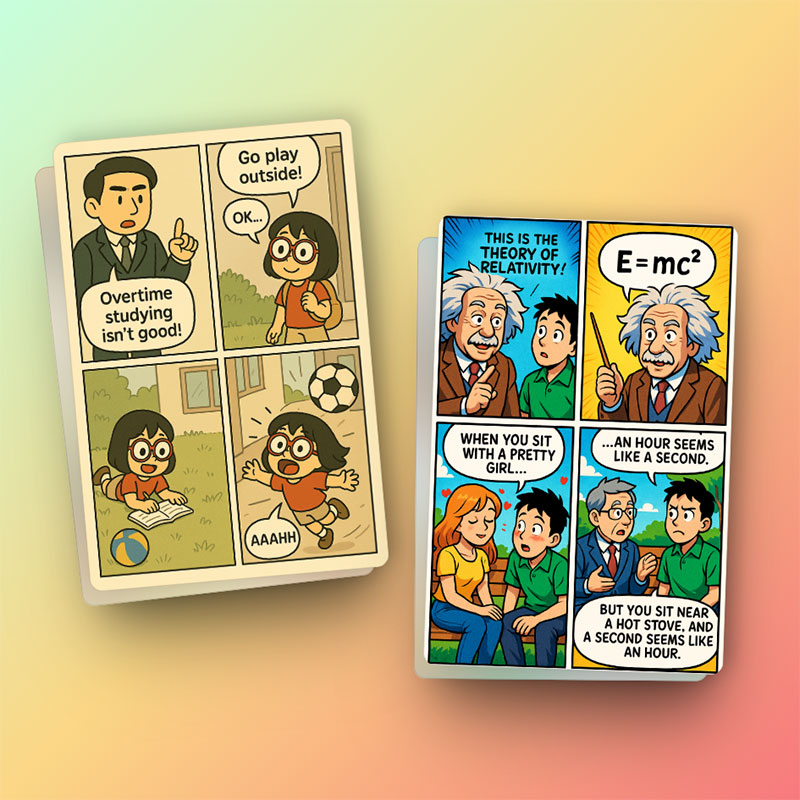
Generate ultra-realistic comic art with AI. Features detailed textures, natural lighting, and photorealistic aesthetics for immersive visual storytelling.
Quick facts
Primary keyword
Compatible formats
Best for
Realistic style AI comics push the boundaries of visual storytelling by offering photorealistic quality within a sequential art format. This style bridges the gap between photography, cinema, and comics, delivering images with lifelike textures, natural lighting, and accurate anatomical proportions. Ideal for serious dramas, sci-fi epics, and historical fiction, the realistic style immerses readers in a world that feels tangible and believable. Our AI generator creates high-fidelity images that look like movie stills or high-end concept art, bringing a level of detail and immersion that traditional stylized comics cannot match. Whether you want to create a cinematic graphic novel or a gritty crime thriller, realistic style provides the visual weight and gravity your story demands.
Renders materials like skin, fabric, metal, and environments with lifelike detail, creating a tangible sense of reality in every panel.
Simulates complex real-world lighting scenarios, including volumetric light, subsurface scattering, and accurate shadows, enhancing the dramatic mood.
Adheres to realistic human proportions and facial features, avoiding the exaggeration of cartoons or manga for a grounded, believable cast of characters.
Uses depth of field and atmospheric perspective to create a sense of three-dimensional space that draws the reader into the scene.
Creates a reading experience akin to watching a movie, perfect for stories that rely on immersion and suspension of disbelief.
Delivers a premium, sophisticated look often associated with high-budget graphic novels and concept art books.
The grounded visual style lends weight and seriousness to mature narratives, journalism comics, or historical recountings.
While detailed, the realistic rendering helps improved understandability of complex mechanical designs, environments, or medical/technical subjects.
Ground fantastical elements in reality, making spaceships, aliens, or magic feel like they truly exist in the physical world.
Perfect for gritty detective stories where the texture of a rainy city street or the subtle expression on a suspect's face matters.
Recreate historical periods with accuracy and detail, transporting readers back in time with convincing visuals.
Ideal for instructional comics or medical illustrations where accuracy and clarity of representation are paramount.
Use camera terminology like '85mm lens', 'macro shot', 'f/1.8 aperture', or 'cinematic lighting' to guide the AI's rendering engine.
Describe textures explicitly, such as 'weathered leather', 'rusting metal', or 'porous skin' to maximize the realistic effect.
Include atmospheric descriptors like 'foggy morning', 'harsh noon sun', or 'dimly lit room' to create realistic environmental context.
Avoid descriptions that imply exaggeration. Focus on 'natural pose', 'candid expression', or 'realistic interaction'.
Include keywords like '8k', 'ultra-detailed', 'photorealistic', and 'masterpiece' to ensure the highest fidelity output.
Realistic style stands apart from all other styles by aiming for fidelity to the real world. Unlike the abstractions of Cartoon or Pixel Art, it seeks to hide the 'artist's hand'. It is less stylized than American Comic or Manga, avoiding outlines and ink effects in favor of value and color rendering. Compared to Watercolor or Sketch, it is tighter and more precise. It shares some DNA with Cyberpunk style in terms of detail, but lacks the specific neon/tech aesthetic unless requested.
It aims to look like a high-quality photograph or a frame from a live-action movie. It can sometimes have a 'painted realism' look similar to high-end concept art.
Realistic faces have more details, so minor variations can be more noticeable. Using consistent character names and detailed physical descriptions helps maintain likeness.
Yes, you can request 'black and white photography style' or 'film noir aesthetic' for a realistic monochromatic look.
Yes, realistic generation typically requires more processing power to achieve high-fidelity details, so it is often a premium feature.