
Clean Lines and Shapes
Utilizes smooth, vector-quality lines and basic geometric forms creates a tidy, organized visuals free from messy textures.
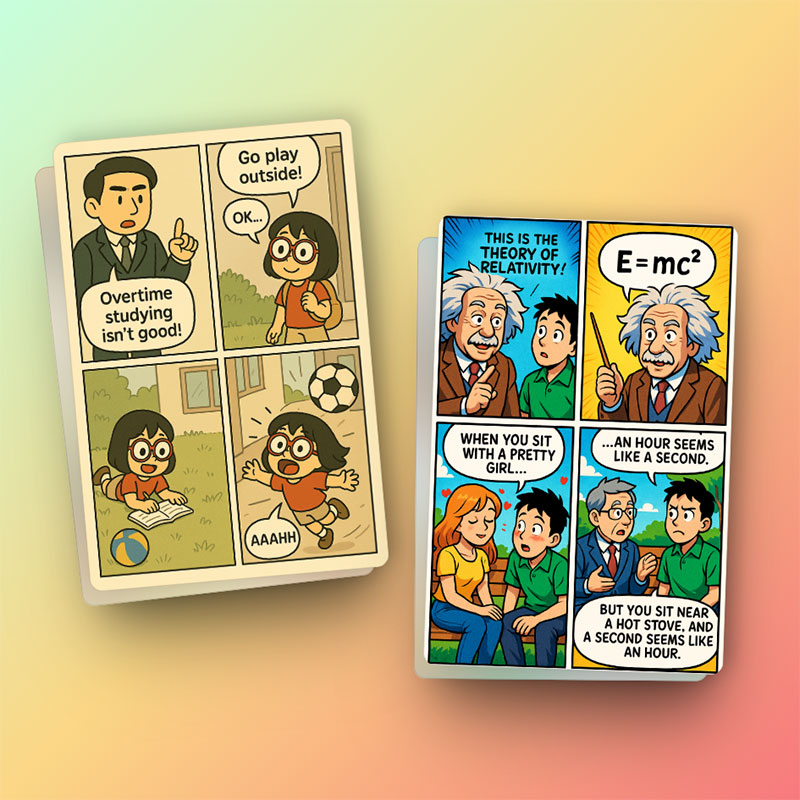
Create elegant minimalist comics with AI. Features clean lines, simple geometric shapes, and modern aesthetics for sophisticated visual storytelling.
Quick facts
Primary keyword
Compatible formats
Best for
Minimalist style AI comics prove that less is truly more. This modern, sophisticated aesthetic strips away visual clutter to focus entirely on the essence of the subject: shape, line, and negative space. Characterized by flat vector-like graphics, limited color palettes, and geometric abstraction, minimalist comics communicate complex ideas with efficiency and elegance. Ideal for corporate storytelling, instructional guides, editorial illustrations, and modern web design, this style conveys professionalism and clarity. Our minimalist generator creates sleek, contemporary visuals that look at home in a tech startup's blog, a lifestyle magazine, or a high-end app instruction manual.
Utilizes smooth, vector-quality lines and basic geometric forms creates a tidy, organized visuals free from messy textures.
Avoids gradients and complex shading in favor of solid blocks of color (flat design), creating a modern 2D look popularized by tech UIs.
Uses white space effectively to balance the composition, giving the eye rest and emphasizing the main subject.
Often represents objects and characters as icons or symbols rather than literal depictions, ideal for abstract concepts.
By removing background noise and texture, the viewer's attention is directed 100% to the core message or action.
The clean, safe, and modern look is the industry standard for business communications, avoiding the 'juvenile' stigma sometimes attached to comics.
Minimalist images can be processed by the brain instantly, making them perfect for infographics and quick social media scrolling.
Simple geometric designs age better than trendy detailed styles, giving your content a longer shelf life.
Perfect for explaining statistics, processes, or workflows where visual clarity is paramount.
The standard visual language for explaining software features ('Corporate Memphis' style) and app onboarding.
Great for accompanying articles about business, psychology, or lifestyle in a sophisticated way.
Visual IKEA-style guides that illustrate actions clearly without language barriers.
Use keywords like 'flat vector art', 'corporate memphis', or 'icon style' to trigger the flat coloring look.
Request '2-color palette', 'monochrome with red accent', or 'pastel tones' to keep the colors controlled and elegant.
Use geometric terms like 'angular', 'rounded corners', or 'silhouette' to guide the character shapes.
Explicitly ask for 'white background' or 'solid color background' to maintain the minimalist isolation of the subject.
Minimalism is great for metaphors. Prompt for concepts like 'teamwork', 'innovation', or 'growth' rather than detailed physical scenes.
Minimalist style is the most abstract of all styles. It sits opposite to Realistic and Cyberpunk styles, which rely on high detail. Unlike Cartoon style, which is expressive and bouncy, Minimalist style is restrained and static. It shares the 'clean' aspect of Manga but removes the black ink lines and hatching. It is similar to Pixel Art in its restriction of detail, but uses smooth vectors instead of blocky pixels.
Not if done right. Good minimalism uses composition and color theory to create striking, memorable images that stick in the mind.
Yes, but they are usually simple (dots for eyes). Some modern minimalist styles ('Corporate Memphis') intentionally omit facial features tailored for universality.
No, stick figures are crude. Minimalist art implies volume and design skill using simplified shapes, looking intentional and professional.
It can have 'complexity', but not 'clutter'. You can have a complex machine drawn with clean lines, but it won't have dirt, rust, or lighting noise.